“…Live, Travel, Adventure, Bless, and don’t be sorry…”
- Jack Kerouac, On the Road
The above quote truly encompasses the main ideals of Kerouac’s 1950’s classic. The story revolves around the lives of two writers, Sal Paradise and Dean Moriarty, who decide to travel across the country in search of inspiration for their literature. It is believed by most that Kerouac based these two main characters on himself, and his travels and encounters across the country. These two men travel across America four times in just a little over three years, and at many points in time, they lose touch with who they are as people. It is in this era that the “Beat Generation” began.
Most people are familiar with the LSD and marijuana experimentation throughout the 1960’s, as people quickly jumped on board the “counterculture” band wagon. This is seen as a groovy time period, and many contribute the use of marijuana and acid for giving us great music from Beatles, The Doors, Jimi Hendrix and The Who. However, most people don’t realize that the experimental, liberal ideals of the Counterculture movement actually stemmed directly from the Beat movement of the 50’s.
To be “Beat” meant a trend towards non-conformity. People such as Kerouac believed that to conform to society extinguished the flames which make us creative and unique from one another. His method of expressing non-conformity was to be constantly in motion, and constantly isolated from the stationary, stable society. A rolling stone gathers no moss was an expression that struck deep in Kerouac’s heart. Connecting back to the allusion of ‘60’s music, the beat generation favored the free flowing, innovative sounds that were quickly becoming popular during this time period. The “Jazz Age” had resonated through time from the Roaring Twenties, right up to the early ‘50’s. At one point in the novel, Moriarty is explaining to Paradise the definition of “it” when referring to musicians. When a musician had “it” they understood their craft to the point where they had finally transcended logical understanding—to a place where man existed as an individual. Mainly, the characters of the novel find their own ways of transcending the mundane aspects of life; unfortunately, they resorted to drugs and binge drinking.
Many people will ultimately love this book because you can’t help but appreciate the dramatic affect it had on society. Dr. Hunter Thompson, considered to be the father of "Gonzo" Journalism (a style of writing where the author will place himself in the situations he is writing about, to the point where he becomes the center of the plot) considers Kerouac his main source of inspiration. Thompson went on to write Fear and Loathing in Las Vegas (yes, the movie starring heart throb, Johnny Depp). Both Thompson and Kerouac proved society was undergoing dramatic change because they were both able to write about drugs and alcohol so vividly-- and become famous for it.
However, the author’s writing skills were very lax, and non-descriptive. Generally, Kerouac was more caught up in his message than conveying exactly what he felt during his travels. The only time the reader is allowed to feel as Sal does, is when he describes a week long party he exchanged less than 5 words to any one person. If the author has reached a point in his life where he no longer recognizes himself, how is the reader supposed to get in touch with whom the author is; or for that matter, what is the message he is trying to convey?
...and if the "fish" thing wasn't at the bottom of this blog site...I probably would've posted this about 30 minutes ago. It's not even a game and it was able to distract me for that long!! loll
Thursday, September 16, 2010

No Exit by Jean-Paul Sartre
Garcin: "Alone, none of us can save himself or herself; we're linked together inextricably."
-pg 38
This quotation may seem very simple and minute, however; the meaning behind it holds a lot of truth. This quote is not only quintessential to the play, but it is also a tremendously important concept that all human beings should remember.
To fully understand this quote, I will have to give a very brief summary of what occurred before this quote was stated. In the beginning of the novel, the reader is introduced to one of the three main characters, Garcin. Garcin finds himself in hell or to be more specific, Jean-Paul Sartre’s version of hell. Garcin does not once question his placement in hell and automatically realizes that he is in hell for a reason. However, Garcin wants to dwell on his shortcomings by himself and does not want to share them out loud. Later on in the play, the other two main characters are introduced, Inez and Estelle. Like Garcin, Inez fully understands the gravity of their situation and also acknowledges that she too deserves to be in hell. Estelle on the other hand, is very different from her cohorts; she is distracted by superficial things and she believes that her placement in hell was an accident. After some time, the three characters decide to reveal their iniquities to each other. In order to not ruin the book, I will not discuss their sins.
Shortly after confessing their sins, Garcin states, “Alone, none of us can save himself or herself; we're linked together inextricably.” Garcin acknowledges the fact that human beings have the power to set other people free from their pain, shortcomings, and inequities. After realizing this, Garcin spends the remainder of the play trying to win the favor of the remaining characters.
I know to some people, this small quotation may seem insignificant, but I truly believe that this quotation speaks volumes. I really love that through a few short simple words, Jean-Paul Sartre is able to explain something of such great magnitude. Through this quote, readers learn that we possess the power to set other people free of all their insecurities, flaws, and sins. Until a human being is convinced by other members of society that his actions are acceptable, he will not be able to possess a clear conscience. Most people do not realize how influential they are in some one’s life. Our thoughts and opinions about an individual can be in some cases the difference between life and death. For me, this quote was life altering. After reading this quotation, I have become really pensive of how I treat other people and I sincerely do not want to be the cause of any anguish in another individual’s life.
Overall, I really enjoyed the play. I would definitely recommend this book to everyone (by the way it is only about sixty pages long so that is definitely a bonus!). I genuinely believe that when this play is read carefully with an open mind, the reader can learn very important things about their own life.
Wednesday, September 15, 2010
What's your name, trooper?
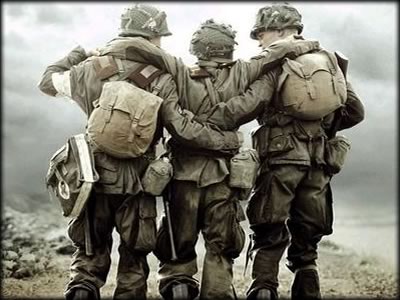
Private BLITHE: Lieutenant. Sir, when I landed on D-Day, I found myself in a ditch all by myself. I fell asleep. I think it was those air sickness pills they give. When I woke up, I didn’t really try to find my unit. To fight. I just..I just kind of stayed put.
Lieutenant SPEIRS: What’s your name trooper?
Private BLITHE: I’m Blithe, Sir. Albert Blithe.
Lieutenant SPEIRS: You know why you hid in that ditch Blithe?
Private BLITHE: (whispers) I was scared…
Lieutenant SPEIRS: We’re all scared. You hid in that ditch because you think there’s still hope. But Blithe…the only hope you have is to accept the fact that you’re already dead. And the sooner you accept that, the sooner you’ll be able to function as a soldier is supposed to function. Without mercy. Without compassion. Without remorse. All war depends upon it.
-Chapter 6, Pg. 89
Of all the conversations, events, and anecdotes that Military Historian Stephen E. Ambrose describes in his work Band of Brothers, which documents the triumphs and travails of an experimental Parachute Infantry Regiment outfit known as Easy Company, the above-quoted dialogue is one of the most direct statements of the mentality of a paratrooper, and in that way contributes more than any other passage to the prevalent themes of the story: suffering as a means of building character and the hopelessness of warfare. Obviously, these are two themes that, at first glance, appear extremely grim and depressing. Upon more careful observation, however, one should realize that Lieutenant Speirs was not trying to depress or alienate Blithe; indeed no leader would ever wish to intentionally deflate their followers’ spirits; but rather, Speirs was simply trying to harden Blithe and expose him to the reality of war, thus transforming him into a better solider and more efficient “killing machine,” more likely to survive combat . Speirs simply uses the concept of hopelessness as a means of building character to do so. In the beginning of this dialogue, Blithe takes on an apologetic tone: he knows and regrets that he failed his fellow paratroopers on D-Day by falling asleep and avoiding his combat duties. He blames his cowardice on fear, claiming that being scared kept him from searching for his comrades and carrying out the invasion. Lieutenant Speirs, on the other hand, offers an alternative explanation: Speirs claims that it was hope, not fear, which kept Blithe static in his ditch. One may think, “Fear is a much more sensible explanation. After all, how can hope make one hesitate? Aren’t hope and hesitation opposites?” If this is going through your mind (as it was going through mine at first,) then think about it this way: When confronted by threatening circumstances, one hesitates, or avoids the threat, because they believe that avoiding the threat will allow them to live in comfort for another day. Facing a threatening circumstance guarantees discomfort in some shape or form, while avoiding that threat guarantees comfort, life, and stability. This explains why one would not leap off a cliff or provoke a gunman: avoiding these behaviors guarantees comfort and life, while engaging in them puts one at great risk for harm. Thus, possessing hope, and the ensuing belief that there are peaceful, stable, and pain-free alternatives to threatening circumstances, are both necessary corollaries to hesitation. Without hope, one can gain nothing from hesitation, for there is nothing beneficial gained by avoiding a threat. In short, without something to live for, without hope and the possibility of comforting alternative circumstances, threats are meaningless, and hesitation has no value. This is what Speirs meant when he said “You hid in that ditch because you think there is still hope."
Speirs expounds on the theme of hopelessness by stating that in order to function properly as a soldier, with the chutzpah and bravery required for war, every solider must realize that he is “already dead.” By this, Speirs meant that there is no hope in war, no better conditions to strive for, and no life to live outside of enemy lines. Thus, upon receiving a daunting mission, a soldier is reduced to two grim alternatives: to refuse the mission and die in abject solitude and isolation, or to carry out the mission and die proudly next to his comrades. This is the mentality on which soldiers on the front-line thrive; the psyche that compelled the men of E. Company to fight for their country; the reason that hopelessness is seen as a means of building character. All of this is captured by this one dialogue, making it, in my opinion, an essential passage indeed. In the second half of Band of Brothers, Speirs translates his “already dead” philosophy into action when he runs right across a field filled with German Infantry and tanks, dodging bullets as he goes, delivers a message to Item Company, and runs right back. To most men, it is seen as insane, while to Speirs, it is seen as the hallmark of a good soldier.
As one can tell, this passage is not written in skillful prose, nor does it possess any beautiful, descriptive language; the style is simple and curt, with no impressive use of syntax, vocabulary, or literary techniques. It's certainly no "Imaginary Iceberg." This is appropriate, however, since the passage is simply a dialogue between two ordinary citizen soldiers, and not the writing of some intellectual. Thus, I cannot say that the passage “jumped” at me as so “beautiful, descriptive, or graphic,” but I can say that the simplicity of the language, and the straightforwardness with which Speirs delivered his mini-speech, made the passage more alluring than beautiful or descriptive language ever could. The primary reason for this is that the simple style made it clear that the passage was written by laypeople and for laypeople, making the message extremely relatable and easy to understand. The rest of the story, on the other hand, is rife with military jargon and history. If one is not intimately familiar, for example, with the military chain of command or the difference between a mortar and howitzer and a .3cal and a .5cal, then the story can at times be difficult to understand. That is not the case with this passage. Anyone can understand this passage, and more importantly, anyone can relate to the themes of fear, hopelessness, and the desire to simply “fall asleep” and avoid responsibility. Therein lays the appeal of Lieutenant Speirs’ speech.
The strong emotional response it elicits, combined with the contributions it makes to the overarching themes of hopelessness and suffering, together made this dialogue an obvious choice for this “essential passage” assignment. My emotional reaction to the passage as a reader, however, was manifold, as several different emotions and thoughts passed through me at once. My first emotional responses were confusion and disagreement. Before reading Band of Brothers, I believed that soldiers must remain hopeful if they wish to do well in war. I envisioned the mentality of a solider as one of optimism, of hope that if all goes well, then everyone can return home to a life of tranquility. I thought that soldiers must be shrewd, and that they must always consider the family and fellow citizens they have to live for. “If you consider your family, you won’t do anything too risky and you will live to fight another day” was my belief, and that’s really how I thought wars were won. Speirs’ speech therefore contradicted my entire conception of war and of what it means to be a soldier. This confusion and disagreement, however, gradually gave way to awe and sympathy. With this passage, I gained a new respect and admiration for soldiers in our military, the ordinary citizens, like our parents and teachers, who were thrown into a war and forced to endure the very basest conditions of human existence. This passage gave me a new reverence for the leadership abilities of men like Lieutenant Ronald Speirs, who brought solace to men buckling under those conditions. I, in short, fell in love with everything the military represents, and it is because of Band of Brothers and speeches like Speirs’ that I have a stack of war books sitting on my desk waiting to be read.
Hell Hath No Fury Like the Wrath of a Babymama Scorned
Oh my gucci, is it possible that I'm first? Let me bite my tongue, I'm sure Jesse will sneak on to here before I'm able to post.
So one of the books I read this summer was Harry Potter and the Deadly Hallows. While that book was amazing and better than any book we could ever possibly read in English class, that's not the book I'm going to write about. I also read Medea by Euripides. It's a short but very action packed Greek tragic play that involves a woman named Medea (not to be confused with the mad black woman who goes on family reunions and has previously been incarcerated) whose husband has just left her in order to marry the princess of Corinth. While most other women would take this as a time to simply grieve and cry and cuddle up watching movies such as PS: I Love You and The Notebook (or in Medea's case, My Big Fat Greek Wedding) while eating as much Ben&Jerry's as possible, Medea is a vengeful soul, and swears to get revenge on her husband for leaving her so abruptly.
The passage from the play that I chose is pretty simple to understand, but I feel as though it completely explains her reasoning behind all of the actions she later on performs:
"Life has no pleasure left, dear friends --
I want to die."
(Medea, p.6)
Medea says this around the very beginning of the play, when people all around the town are telling each other of the latest gossip: Jason, Medea's husband, has left her, and Medea is absolutely distraught. Everyone is fearing for the safety of themselves, Medea, and most importantly, her children. It is the essential essence of the plot, the fact that she wants to reciprocate what Jason has done to her; she wants to make him feel as grief-stricken as she has felt, and will go to any lengths to do so. It is the motive that Medea uses to justify the atrocities that she will soon commit, the fact that she no longer cares whether or not she lives or dies, because everything she once lived for is gone.
It's crazy to think that the loss of a husband could affect a woman so intensely, however it's apparent that Medea no longer has any regard for herself or her well-being. By this, I mean that in her eyes, her life is over, and she no longer has a reason to be careful or conscious of some actions that might get her in trouble. As of this moment in her life, nothing could make her feel worse than the way she's feeling now. As soon as I read it, I knew that it was the biggest piece of foreshadowing in the history of literature since Voldemort's soul was blasted apart the night he tried to kill Harry. Medea is already known throughout the town as being a vengeful, impassioned woman who is too intelligent for her own good, and is therefore very lethal. I think I may have actually said "Uh oh" out loud when I read it, because I knew that it could mean nothing good. And while it's not a particularly climactic point in the novel, it commences to begin (haha) the steamroll of events that lead to the eventual climax. In a work of literature as short as this one, it could be very difficult to determine the climax and any foreshadowing that may be present; but this passage was as blatantly "in-your-face" as Lady Gaga's meat dress - there was no way you could miss it.
So basically, that's all you need to know about Medea. I did my best not to reveal the ending because I really do recommend this play to everyone who hasn't read it, it's so... juicy. So dramatic and crazy and it was just great, I loved it, and (mainly because it's so short) I'm sure everyone will enjoy it too. I will, however, end by giving this one little clue as to the ending of the play, a phrase I have stated many times in and out of English class: "She was killing eh-body."
That is all.
So one of the books I read this summer was Harry Potter and the Deadly Hallows. While that book was amazing and better than any book we could ever possibly read in English class, that's not the book I'm going to write about. I also read Medea by Euripides. It's a short but very action packed Greek tragic play that involves a woman named Medea (not to be confused with the mad black woman who goes on family reunions and has previously been incarcerated) whose husband has just left her in order to marry the princess of Corinth. While most other women would take this as a time to simply grieve and cry and cuddle up watching movies such as PS: I Love You and The Notebook (or in Medea's case, My Big Fat Greek Wedding) while eating as much Ben&Jerry's as possible, Medea is a vengeful soul, and swears to get revenge on her husband for leaving her so abruptly.
The passage from the play that I chose is pretty simple to understand, but I feel as though it completely explains her reasoning behind all of the actions she later on performs:
"Life has no pleasure left, dear friends --
I want to die."
(Medea, p.6)
Medea says this around the very beginning of the play, when people all around the town are telling each other of the latest gossip: Jason, Medea's husband, has left her, and Medea is absolutely distraught. Everyone is fearing for the safety of themselves, Medea, and most importantly, her children. It is the essential essence of the plot, the fact that she wants to reciprocate what Jason has done to her; she wants to make him feel as grief-stricken as she has felt, and will go to any lengths to do so. It is the motive that Medea uses to justify the atrocities that she will soon commit, the fact that she no longer cares whether or not she lives or dies, because everything she once lived for is gone.
It's crazy to think that the loss of a husband could affect a woman so intensely, however it's apparent that Medea no longer has any regard for herself or her well-being. By this, I mean that in her eyes, her life is over, and she no longer has a reason to be careful or conscious of some actions that might get her in trouble. As of this moment in her life, nothing could make her feel worse than the way she's feeling now. As soon as I read it, I knew that it was the biggest piece of foreshadowing in the history of literature since Voldemort's soul was blasted apart the night he tried to kill Harry. Medea is already known throughout the town as being a vengeful, impassioned woman who is too intelligent for her own good, and is therefore very lethal. I think I may have actually said "Uh oh" out loud when I read it, because I knew that it could mean nothing good. And while it's not a particularly climactic point in the novel, it commences to begin (haha) the steamroll of events that lead to the eventual climax. In a work of literature as short as this one, it could be very difficult to determine the climax and any foreshadowing that may be present; but this passage was as blatantly "in-your-face" as Lady Gaga's meat dress - there was no way you could miss it.
So basically, that's all you need to know about Medea. I did my best not to reveal the ending because I really do recommend this play to everyone who hasn't read it, it's so... juicy. So dramatic and crazy and it was just great, I loved it, and (mainly because it's so short) I'm sure everyone will enjoy it too. I will, however, end by giving this one little clue as to the ending of the play, a phrase I have stated many times in and out of English class: "She was killing eh-body."
That is all.
Subscribe to:
Posts (Atom)